
You read the RFP, decide it's worth bidding, and start writing. On day 16, the scope changes, and you find out the next time you happen to check the portal.
We followed 539 state, local, and tribal government Requests for Proposal (RFPs) from the day they posted to the day they were due. A hundred and thirteen of them, more than one in five, changed their terms before the deadline. The first change landed a median of 16 days into a 25-day window, which is to say after most of the proposal work is already done.
What we found
More than one in five RFPs changed their terms after posting: the scope, the deadline, how to submit, or the documents themselves.
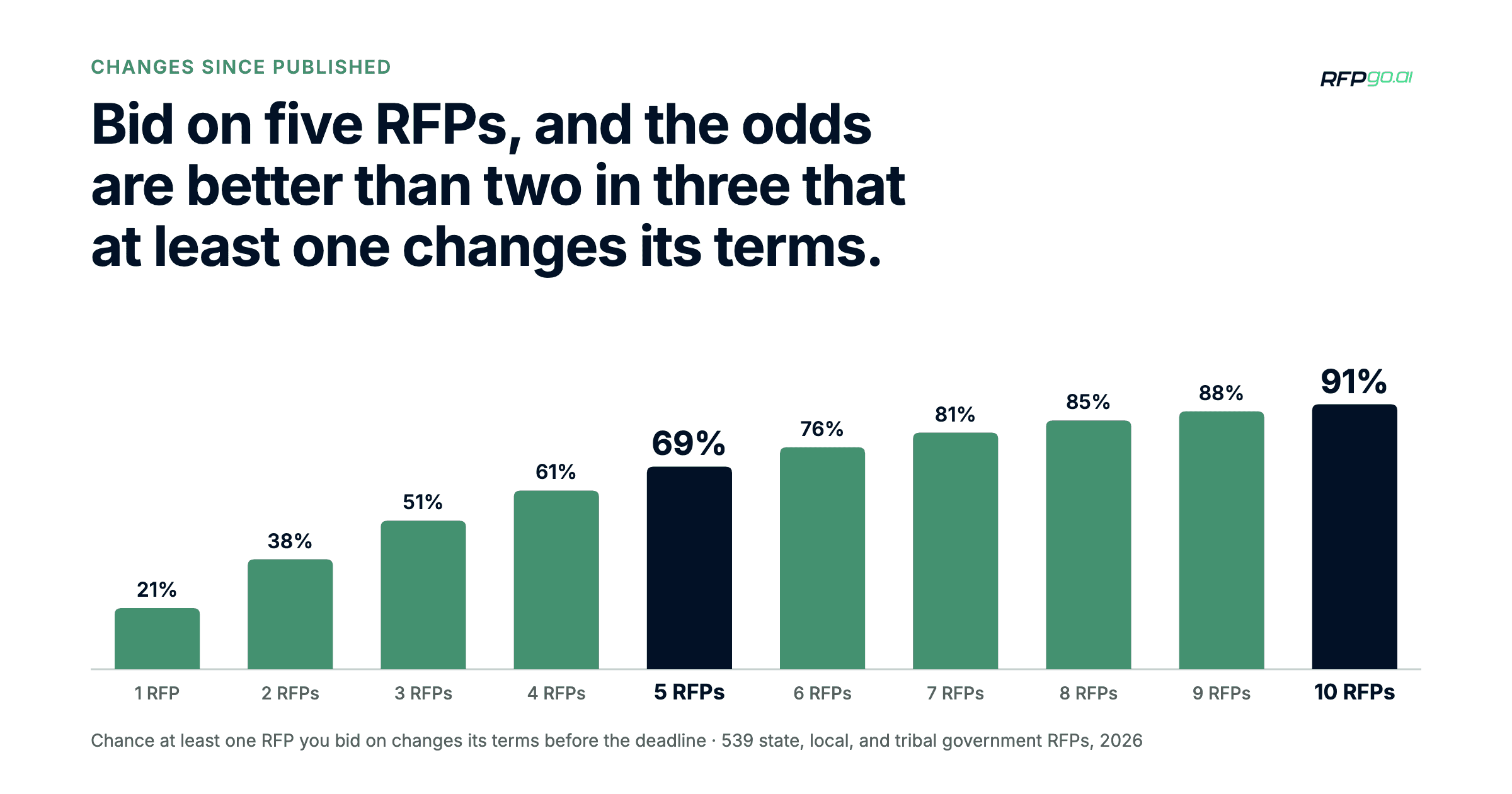
Bid on five RFPs, and the odds are better than two in three that at least one changes its terms. Bid on ten, and it's nine in ten.
Two-thirds of first changes landed after the halfway point of the bidding window.
38 of the 113 changed only inside a questions-and-answers (Q&A) document. No addendum, no notice.
Nearly one in four of the changed RFPs changed again, about a week later, and usually to something different.
What counts as a change
Every RFP is a set of terms: what the government entity wants, how it wants it submitted, what it will pay, and when the proposal is due. A firm decides whether to bid on those terms. So the question is how often they hold.
We counted a filing as a term change if it moved the deadline, changed the scope or requirements, changed how to submit, recalled or replaced a document, changed the budget, or canceled the RFP. A Q&A answer that did any of those counts.
By that rule, 113 of 539 RFPs changed at least once: 21%, carrying 141 term changes between them. That is the conservative reading. Two in five of the cohort had some filing during the window; we only counted the ones that changed what a bidder had to do.
One in five sounds like the exception until you bid on more than one. Draw five RFPs at random from the 539, and at least one of them changed its terms 69% of the time. Draw ten, and it was 91%.
What changed
Of the 113 RFPs that changed:
53% moved the deadline. Every dated move but one was an extension.
45% changed the scope or requirements: a deliverable added or dropped, a qualification tightened, a page limit or insurance requirement revised.
38% changed how to submit: a new portal, a different address, a revised form, a changed bid time.
Sixteen recalled or replaced a document. Seven were canceled outright, anywhere from four weeks before the deadline to the day proposals were due.
Three changed the budget. When a budget is stated, it almost always stays.
Those overlap because 45% of the changed RFPs changed more than one thing, often in the same filing. A deadline extension rarely arrives alone; it usually comes with the answers that made it necessary.
It changes late
This is the finding that matters most. The first change landed a median of 16 days after posting, in a median window of 25 days.
Two-thirds of first changes came after the halfway point of the window.
More than a third landed inside the final seven days.
About one in seven landed inside the final three.
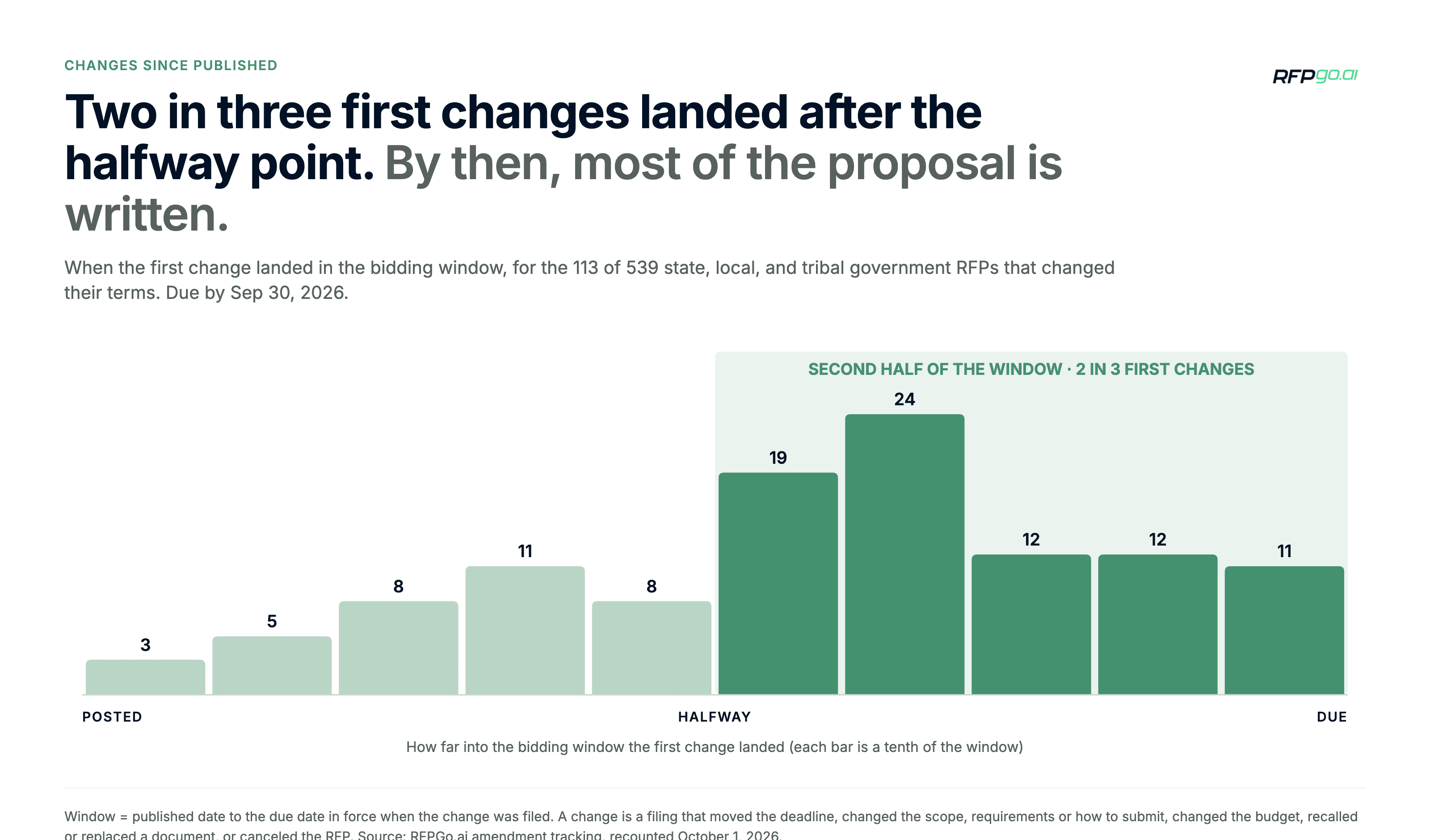
That timing is the rhythm of procurement, not carelessness. The question period closes partway through the window, the answers follow, and the answers are where the terms move.
The answers are the amendment
A hundred and fifty of the 539 RFPs posted a Q&A document, 208 documents in all. Fifty-one of those answer sets changed the terms without a separate addendum. And 38 of the 113 changed RFPs were changed only inside a Q&A.
If your process treats the Q&A as background reading and the addendum as the thing to watch for, you will miss a third of the RFPs that change.
What to do about it
Treat the terms as a draft until day 16. Make the go/no-go call early, and plan for the requirements to move once.
Read the Q&A as an amendment. Whoever owns your compliance checklist should read every answer, not just the ones to your own questions.
When it changes once, expect a second change, about a week later, and usually to something different. A scope change is a signal, not an event.
Don't count on an extension. Only 51 of 539 got one, and the median was 7 days. Plan against the published deadline and treat an extension as found time.
Check again inside the final week. That's where more than a third of first changes land, after most teams have stopped watching the portal.
Large firms have someone watching every portal, every day. A moved deadline costs them an afternoon. Everyone else finds out late.
RFPGo follows every RFP from posting to deadline: every amendment, notice, recalled document, and Q&A answer, labeled by what it changed, with a plain summary of what it means for your bid. Explore active RFPs →
The detail, for those who want it
The deadlines that moved
Fifty-three RFPs moved their deadline, and 51 of them got more time: 57 extensions in all, with a median of 7 days. Ten ran 1 to 3 days, 27 ran 4 to 7, and 17 ran 8 to 14. Eight got a full two weeks, among them a Salesforce test-automation RFP, a countywide energy management plan, a substation project, and an extreme-heat resilience program. Three ran longer still, at 17, 24, and 28 days.
One went the other way. A state data-platform RFP in Oregon extended its deadline twice in one day, pulled it back a week the next day, and pushed it out again six days later.
One caveat on the top end. Because the cohort only includes RFPs due by September 30, any RFP pushed past that date fell out of the count. Among the 27 excluded that way, the longest extensions ran 18, 21, and 28 days. So read "median 7 days" with confidence, and expect the long tail to run longer than this cohort shows.
The 26 that changed twice
Twenty-six RFPs changed their terms twice or more. Twenty-four changed twice; two changed three times. Three things stand out.
The second change is usually a different kind of change. Nineteen of the 26 changed something different the second time: a scope change followed by a deadline move, a submission change followed by a recalled document.
The gap is about a week. Median gap between first and second change: 7.5 days.
The second change lands late. Sixteen of the 26 took their last change inside the final week. Seven took it within a day of the deadline.
Two examples:
Central District Black Legacy Plan (city, Washington), one of two RFPs that changed three times. Posted August 1 with a three-week window. On August 18, the deadline moved to August 29; on August 24, the scope changed; on August 27, the deadline moved again to September 12. Three filings turned a three-week window into six.
Web Content Management System (city, California), a 15-day window. A Q&A changed the submission process on day 8, and a second Q&A changed the scope and submission requirements one day before proposals were due.
Method and sources
Cohort: 539 professional services RFPs published by RFPGo.ai between July 23 and September 23, 2026, with a due date on or before September 30 (Pacific). RFPs extended past that date are not in the cohort.
Filings: every addendum, notice, document, Q&A, recall, and cancellation logged against those RFPs, pulled October 1, 2026. Removed three duplicate filings, leaving 141 term changes.
Term change: a filing that moved the deadline, changed the scope or requirements, changed how to submit, changed the budget, recalled or replaced a document, or canceled the RFP. A Q&A answer that did any of those counts.
Odds of at least one change: for each number of RFPs from one to ten, that many RFPs were drawn at random from the 539, 200,000 times, counting how often at least one had changed its terms. The result matches the simple calculation from the 21% rate. Rates differ by government entity type, so a firm that bids mostly on county work will see more changes, and one that bids mostly on state work, fewer.
Timing: calendar days, Pacific time, from the RFP's published date. "Deadline in force" means the due date that applied when the change was filed.
Source: RFPGo.ai internal data.