

Some government RFPs are interesting because of what they are buying. Others are interesting because of what they reveal.
The Southern California 511 Web & Mobile App Modernization and Operations RFP does both. The agency behind the procurement is the Los Angeles County Service Authority for Freeway Emergencies, or LA SAFE, while the Los Angeles County Metropolitan Transportation Authority, LA Metro, handles administrative requirements, including certification and contracting processes.
On paper, the opportunity is reserved exclusively for LA Metro-certified small businesses. That matters because set-asides can create real opportunities for smaller firms that might otherwise be crowded out by larger incumbents. But this RFP raises a harder question: what happens when the intended audience is small businesses, but the proposal requirements, response timeline, scope of services, and delivery schedule look more like enterprise-grade public technology work?
The issue is not whether the project matters. It does. Southern California’s transportation environment is complex, and public-facing mobility information must be accurate, accessible, reliable, and useful during everyday commutes, major events, and emergencies. The question is whether the structure of the opportunity aligns with the capacity of the firms it is intended to reach.
From 511 Phone Line to Mobility Platform
Most people probably do not think about 511 unless they need it. That was part of the original idea. In 2000, the Federal Communications Commission designated 511 as the national three-digit telephone number for traveler information. The goal was to give the public an easy-to-remember number for traffic, transit, road conditions, and other travel information. The Federal Highway Administration describes 511 as a tool for helping travelers make better decisions about time, route, and mode.
In plain English, 511 was created to answer practical travel questions: What is traffic like? Is there a road closure? Is transit running? Is there another way to get where I need to go?
Southern California 511 applies that idea across a much larger regional environment. As outlined in the RFP, Southern California 511 is a free, multimodal traveler information service covering Los Angeles, Orange, Riverside, San Bernardino, and Ventura counties. It provides traffic, transit, rideshare, and other transportation information through its phone app, website, mobile app, and social media channels. It also includes motorist aid services for non-emergency assistance, such as towing.
Like most public services, it has evolved and grown. It started as phone-based access to traveler information, then expanded into websites and mobile applications. Over time, real-time data, alerts, personalization, direct messaging, and regional transportation integrations became more important. Now, this RFP points toward the next phase: a public mobility platform that is mobile-first, accessible, multilingual, data-informed, emergency-ready, and continuously operated.
That also means Southern California 511 already has systems, data relationships, operating history, and user expectations. This maturity makes the procurement complex. The next contractor has to modernize an existing ecosystem for what users now expect from digital services: fast information, real-time alerts, maps, personalization, mobile performance, accessibility, and trust during disruptions.
The Title Understates the Assignment
The RFP is titled Website and Mobile App Modernization and Operations Procurement. That title is accurate, but it understates the assignment.
The scope asks for a qualified digital services contractor to modernize, operate, and continuously improve the Southern California 511 website and mobile applications. The contractor is expected to deliver a unified, accessible, user-centered digital platform that positions Southern California 511 as the authoritative source for mobility information across the region.
That is not just a design refresh, a content management system migration, or an app update. The scope includes discovery research, User Experience and User Interface design, full-stack development, security, operations, content strategy, product management support, quality assurance, analytics, and long-term operations and maintenance.
The platform is also expected to support drivers and transit riders, provide timely information during emergencies, scale for the 2028 Olympic and Paralympic Games, and allow the agency to test, iterate, measure performance, gather user feedback, and evolve features over time.
Those goals become more demanding when you look at the 13-plus features the RFP requires the modernized digital platform to deliver. Features like customized alerts across channels and during emergencies, integration with the Interactive Voice Response API, and real-time interactive mapping make this very different from simply posting traffic updates on a website.
The Timeline Is Part of the Barrier
The response timeline and delivery schedule are practical barriers that limit the field. The RFP provides just over a month to review the solicitation, evaluate the scope of services, organize partners or subcontractors, estimate labor, price the work, collect certifications, complete forms, confirm insurance capacity, and submit a compliant proposal package. That package has to be submitted in four volumes with specific instructions for each.
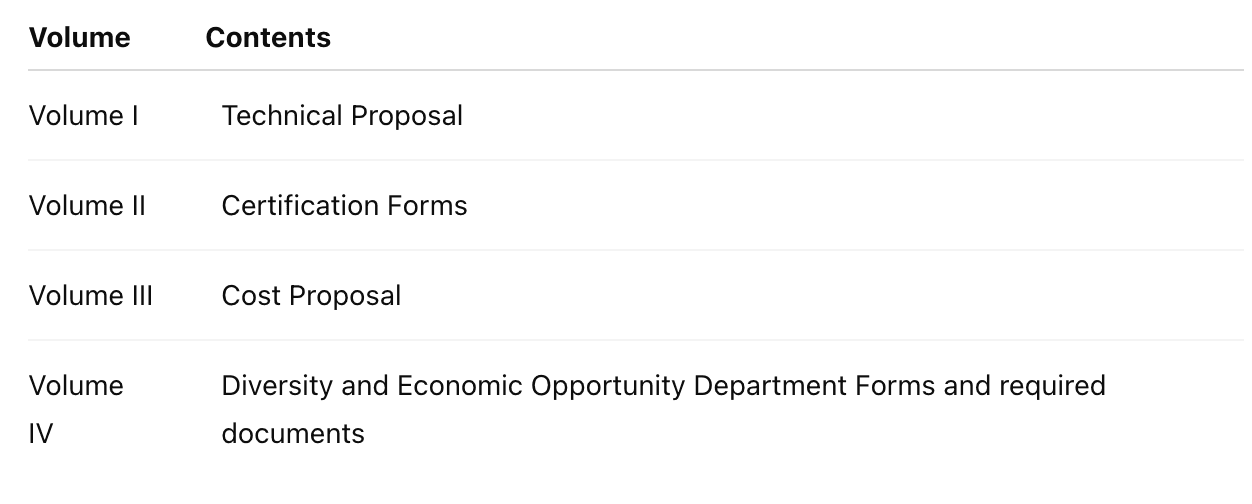
This RFP timeline, coupled with the proposal requirements, is much easier to manage for companies with dedicated business development resources. That is a resource many small businesses cannot afford or fully staff.
The delivery timeline adds another layer of complexity. The required Baseline System Launch for the website and mobile app core features is January 29, 2027. The Extended System Launch is due January 3, 2028. The system must also be fully tested and operational ahead of the 2028 Olympics.
If evaluation, award, and contract execution take roughly three months, the selected small business could have only about three-and-a-half to four months to reach the baseline system launch. An ambitious scope is one thing. An ambitious scope paired with rigorous proposal requirements and an aggressive public launch timeline is something else.
Small Business, But How Many Can Realistically Compete?
This RFP is a Small Business Enterprise set-aside, meaning the competition is reserved for firms that meet LA Metro’s Small Business Enterprise certification requirements and can compete through the applicable vendor and contracting process.
That certification screen narrows the field before the technical evaluation begins. But certification is only the first filter. A credible prime contractor likely needs experience with transportation data, mapping, mobile applications, cloud operations, cybersecurity, accessibility, public-sector compliance, emergency communications, proposal management, and long-term operations. It also likely needs a subcontractor bench capable of filling gaps without slowing delivery.
A small web development shop may be eligible in spirit, but that does not mean it is ready. The realistic pool is probably much, much smaller: certified small-business technology integrators, firms with prior mobility-platform experience, or Small Business Enterprise primes with strong specialist partners already in place.
Put differently, the opportunity is reserved for certified small businesses, but only a small subset likely has the experience, staffing, partnerships, and operational maturity to compete and deliver with confidence.
What the Estimates Reveal
The estimates are not meant to predict the winning bid. They are meant to show why the pool of firms that can realistically deliver this work may be small. Given the breadth of the Scope of Services, the work looks less like a typical small-business web/app project and more like an enterprise-grade public mobility platform modernization.
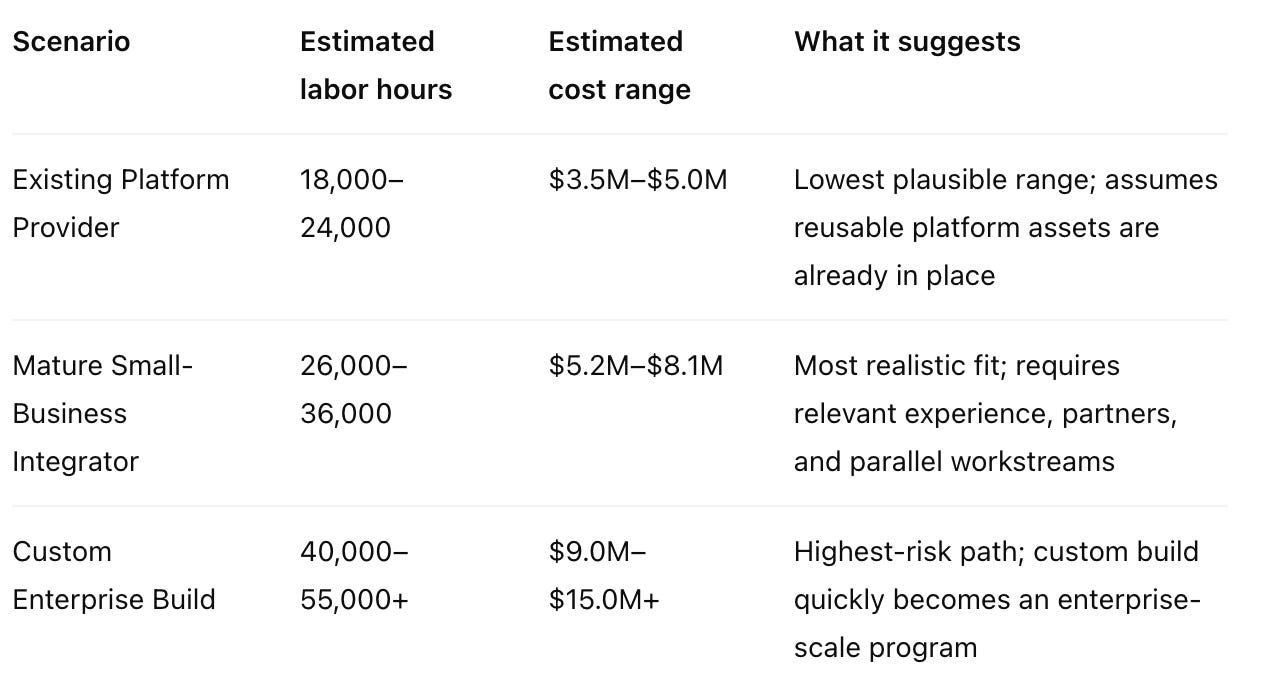
A bottom-up review of the Scope of Services shows why. The work cuts across product strategy, user research, design, accessibility, web and mobile development, platform architecture, content management, maps, trip planning, alerts, personalization, data integration, analytics, security, cloud operations, testing, launch readiness, and ongoing support.
Even the lowest range assumes more than basic technical capability. The realistic range likely requires the equivalent of 20 to 30-plus full-time contributors during peak delivery, including designers, engineers, mobile developers, data specialists, cloud/security staff, Quality Assurance, project management, and subcontractor support.
The estimate reinforces the broader point: this project may be set aside for certified small businesses, but the delivery expectations are closer to those of enterprise-grade public digital infrastructure. That is a very different profile from a small firm simply discovering the opportunity and deciding to pursue it.
Small-Business Set-Aside, Enterprise-Level Expectations
RFPs are often treated as paperwork. But they are also market signals. This one shows how public-sector digital services are maturing. A service that began as an easy-to-remember phone number for traveler information has evolved into a regional digital mobility platform with expectations for accessibility, mobile performance, multilingual content, APIs, analytics, emergency response, uptime, data integration, and continuous improvement.
But the sharper lesson is about alignment. The Southern California 511 RFP is reserved for certified small businesses. That matters. It creates a path for smaller firms to compete for meaningful public-sector technology work.
But the set-aside does not make the work small.
The expectations are enterprise-level. The contractor must understand transportation data, modern mobile application delivery, cloud operations, cybersecurity, accessibility, public-sector compliance, emergency communications, proposal management, subcontractor coordination, and long-term operations. It must also submit a compliant proposal within a short response window and deliver against public milestones tied to the 2028 Olympic and Paralympic Games.
That is the practical challenge. The intended audience is certified small businesses, but the structure of the opportunity may be better aligned with only a narrow segment of that audience: mature firms with strong technical teams, prior platform experience, and enough bench strength to absorb the proposal and delivery burden.
The opportunity is real. So are the enterprise-level expectations.


