Sign up to be the first to know

FAQ
In case you missed anything and had some more questions.
What is RFPGo.ai?
RFPGo.ai is RFP intelligence for small professional-service firms bidding on state, local, and tribal government work. It finds the RFPs that fit you, shows you enough to decide before you open a 60-page PDF, keeps what you're pursuing in one place, and tells you what changed — an amendment that moved the deadline, a buyer's answer that changed the scope — while there's still time to use it. Today that's the Leads plan, covering Idaho, Oregon, Washington, and California. Leads Plus — deeper analysis and the intelligence to kick-start your proposal process — is in development.
What is Leads?
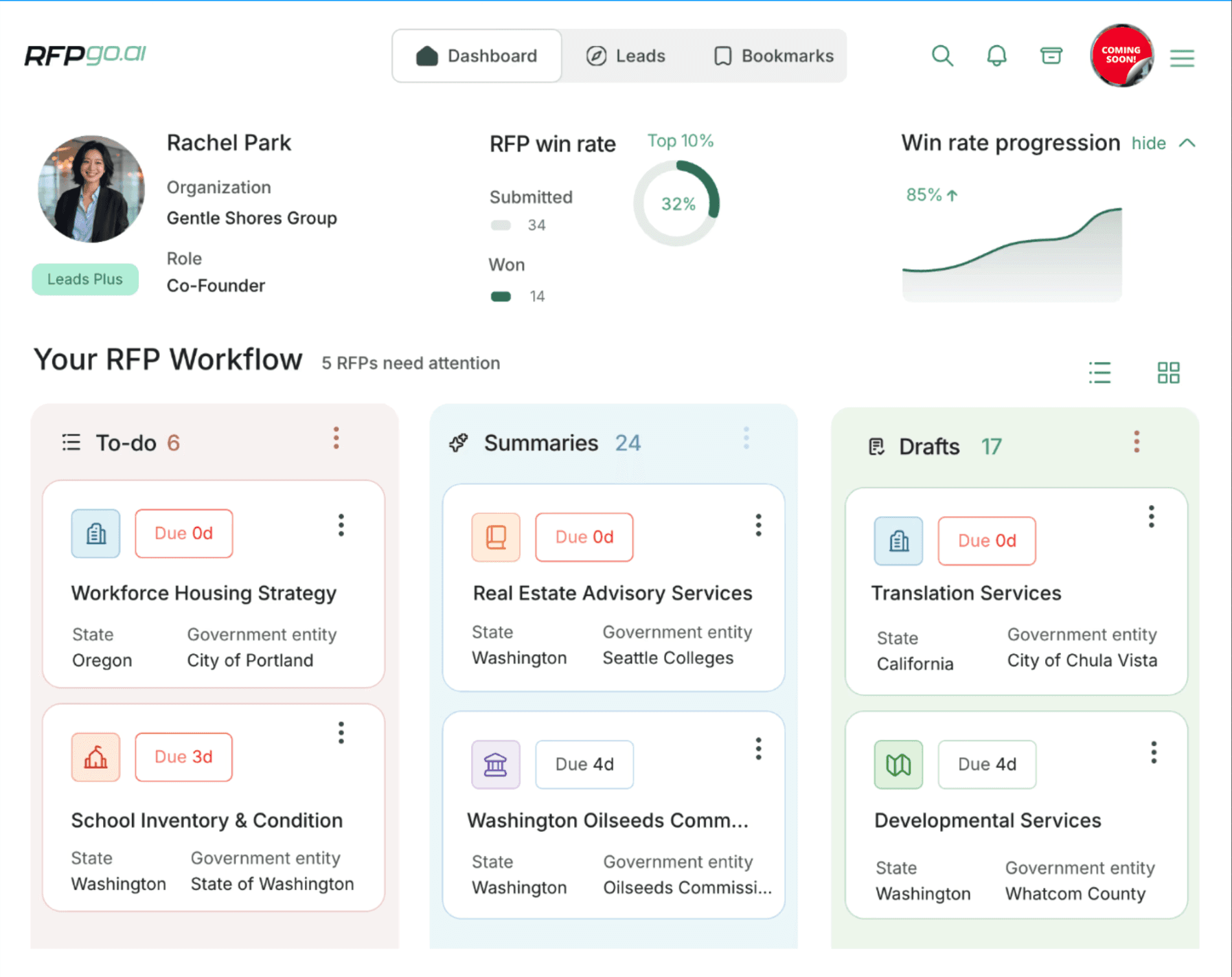
Leads is the RFPGo plan that ships today: professional-service RFPs from Idaho, Oregon, Washington, and California, matched to your firm and followed until they're due. What's in it? – Matched to you: save your NAICS codes and tags once; new RFPs that fit arrive strongest first, with why you're seeing each one. – The decision before the PDF: what they want, who can bid, how to submit, and the due date on one screen, in plain language, with the source documents one click away. – Your pipeline: bookmark what you're weighing, add what you're pursuing to your to-do — no limits. – What moves: Changes since published and What others asked show every amendment and buyer answer as what changed, not just that something did. – A weekly digest of what's new, and a mobile-friendly app for reviewing on the go. Where do the RFPs come from? Hundreds of city, county, tribal, and state-agency sites across the four states, organized the same way every time so you're not learning a new portal per buyer. Do you link to the original documents? Yes. Every RFP links to its source documents so you can verify requirements and download what you need. What does it cost? $47 a month billed annually, or $59 month to month. You can start free, with no card.
What makes RFPGo.ai different?
Most bid services stop at the listing: a link, a title, a due date, and a PDF that's your problem now. When something changes, that's your problem too. RFPGo keeps you in the know on the two things that actually decide a bid. First, whether it's yours to win — every RFP is matched to your NAICS codes and tags, and opens with what they want, who can bid, and how to submit, in plain language. Second, what changed after you decided — deadlines move by amendment, scope shifts in a buyer's answer, and those show up as Changes since published and What others asked: what changed, not just that something did. Everything else — one place for all four states, documents one click away, bookmarks and a to-do list with no limits, a weekly digest, a phone-friendly app — is there so the deciding and the following don't cost you the week.
What is Leads Plus?
Leads Plus is the next tier, in development now. It's for firms that have decided to bid: deeper analysis of the solicitation, and the intelligence to kick-start your proposal process — engineered with insights from current and former government contracting professionals. Your team still owns the strategy, the voice, and the submission. When? We'd rather ship it right than name a date. Everything in Leads carries over. Join the newsletter to hear when it ships, or book a demo for an early look.
What is a request for proposal (RFP)?
An RFP (Request for Proposal) is a formal solicitation from a government entity for services that solve a problem, meet a community need, or cover an administrative requirement. Unlike a price quote, it asks firms to propose how they'd do the work; proposals are then scored against published criteria for best overall value. We use "RFP" broadly. Cities, counties, and state agencies also issue RFQs, RFIs, grants, and similarly named solicitations — when one is for professional services, it's here.
What is a professional service?
NAICS code 54 — Professional, Scientific, and Technical Services. It covers work that sells expertise rather than a product: consulting, planning, legal, accounting, engineering, architecture, design, research, marketing, and the like. We shorten it to "professional services." NAICS matters here for two reasons: it's the system governments use to categorize what they're buying, and it's one of the two things RFPGo uses to match RFPs to you. The other is natural language tags.
What do I get with a free account?
Five RFPs a week, opened in full — what they want, who can bid, how to submit, the source documents, and every change filed since it published — plus the RFPs matched to your NAICS codes and tags. No card required. Bookmarks, to-dos, and change alerts start with a trial.
Which states do you cover?
California, Washington, Oregon, and Idaho — state, county, city, and special-district portals. New England is next.