Government contracting at the state and local level can often feel like just “a bunch of random RFPs.”
However, when you read enough of them, as I do, you start noticing something else: government entities may describe needs with wildly different titles and descriptions, but the underlying needs repeat—and those repeats are a helpful signal for what’s likely to show up next.
This post uses the same dataset as the retrospective (1,275 unique RFPs), but asks a different question:
Given what government entities were buying in 2025 and changing macroeconomic conditions, how could RFPs shift in 2026?
What the eight categories revealed
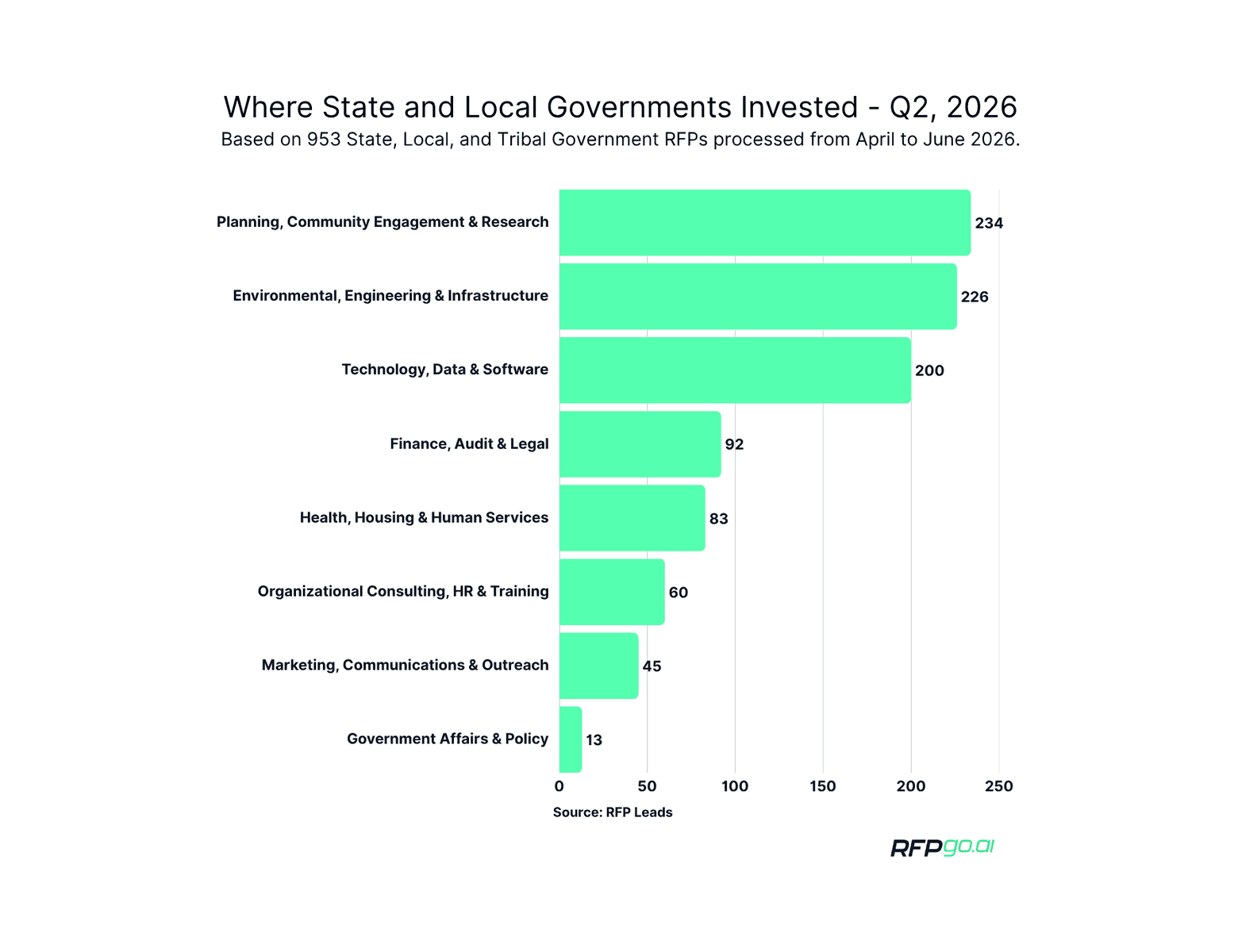
The three biggest buckets were:
Planning, Community Engagement & Research — 28.5%
Technology, Data & Software — 19.3%
Environmental, Engineering & Infrastructure — 16.4%
Even if you ignore everything else, that mix already suggests a direction: more emphasis on defensible decisions, operational modernization, and maintenance of essential systems.
A timing reminder that rarely gets mentioned (but matters)
Most people know that fiscal years vary. It’s worth remembering because it influences when RFPs are queued and how government entities discuss procurements.
Federal fiscal year: Oct 1 → Sept 30
State cycles* differ:
WA & OR: biennial budgets (July 1 of odd year → June 30 of next odd year)
CA & ID: annual budgets (July 1 → June 30)
Most cities and counties align with their state’s cycle — but not all:
Washington County, OR: annual (July 1 → June 30)
City of Portland, OR: annual (July 1 → June 30)
City of Boise, ID: annual (Oct 1 → Sept 30)
That’s not a “gotcha.” It’s just a reminder that the timing of an RFP depends heavily on the budgets that fund the underlying need.
*RFP Leads aggregates and parses state and local RFPs from these states.
Three macro trends that could show up in 2026 RFPs
1) “Do more with less” becomes the operating reality
The Federal Reserve lowered the federal funds target range to 3.50%–3.75% on December 10, 2025 — a cautious easing in the face of economic softness.
Rate cuts don’t automatically expand local budgets. Instead, state and local government entities are sharpening their focus on operational efficiency, clear deliverables, and vendor-driven throughput, especially as revenue forecasts across WA, OR, and CA remain conservative.
How this could show up in RFPs
Stronger emphasis on measurable outputs and timelines
More requests for managed or outsourced services
Language focused on reducing manual work and operational inefficiencies
What this could mean for businesses
You stand out not by being bigger, but by being the partner who removes work, improves throughput, and delivers predictable outcomes.
2) More phased scopes and risk-managed contracts
After a 43-day federal shutdown and multiple short-term continuing resolutions pushing funding only into early 2026, state and local government entities have less confidence in multi-year contracts.
As federal funding becomes increasingly uncertain, procurement shifts toward lower-risk, modular contracting—a trend long supported by NASPO guidance.
How this could show up in RFPs
Smaller initial scopes with clear, discrete outcomes
Option years instead of large, multi-year commitments
More on-call / task-order structures
What this could mean for businesses
This is one of the most favorable environments for small businesses: you can win a Phase 1, show value, and expand — instead of competing for a giant award upfront.
3) Security, resilience — and now AI governance
Cybersecurity pressure on state and local government remains high, with ransomware repeatedly disrupting state, local, tribal, and territorial (SLTT) entities.
But the biggest story heading into 2026 is a shift in statewide technology priorities:
For the first time in 12 years, AI/GenAI has overtaken cybersecurity as the #1 CIO priority.
This doesn’t diminish cybersecurity — it expands it. Agencies now have to secure infrastructure and ensure AI is used securely within those systems.
How this could show up in RFPs
Required continuity and resilience plans
New expectations around AI governance, including transparency, privacy, and responsible-use attestation
Language shifting toward risk-aware, compliant, and governed implementation
What this could mean for businesses
You don’t need enterprise-level certifications — but you must show:
documented security practices
continuity planning
clear, responsible AI-use policies
Small businesses that are efficient, low-risk, and AI-aware will perform well in 2026.
Takeaways for 2026
I’m not trying to predict exact categories or exact volumes. But the direction is visible:
If 2025’s highest RFP volumes were planning, tech, and infrastructure, and 2026’s macro conditions are pushing government entities toward efficiency, risk management, and resilience, then it’s reasonable to expect RFPs to:
emphasize defensible decisions and phased delivery,
seek out businesses that reduce operational burden,
and increase requirements around security and accountability.
That’s the bet I’d make—not on any one headline, but on the intersection of what government entities are buying and the evolving constraints they’re operating under.