
At RFPGo.ai, we review hundreds of government RFPs each month. One aspect that rarely receives attention but has significant process implications is amendment activity. When we analyzed amendment activity across September, October, and November, one structural pattern became unmistakable:
Inconsistent RFP structure → More clarifying questions → More amendments
Thanks for reading RFPGo.ai! Subscribe for free to receive new posts and support my work.
These numbers are the downstream evidence of the upstream problem highlighted in the research from U.S. Digital Response (USDR) and the National Association of State Chief Information Officers (NASCIO), published in February 2025.
1. RFPs Are Organized Differently Everywhere — And It Shows
Across states, counties, and cities, RFPs vary widely in how they present even the basics. Scope, deadlines, submission instructions, required documents, and evaluation criteria may all appear in completely different places—or under entirely different labels—depending on the issuing government entity.
This fragmentation creates a predictable cycle:
Businesses struggle to locate key information.
They ask clarifying questions.
Governments issue amendments to respond.
In short, inconsistency creates confusion, and confusion creates amendments.
2. What the Amendment Data Shows
The patterns in the amendment data clearly reinforce this point. Over the past three months:
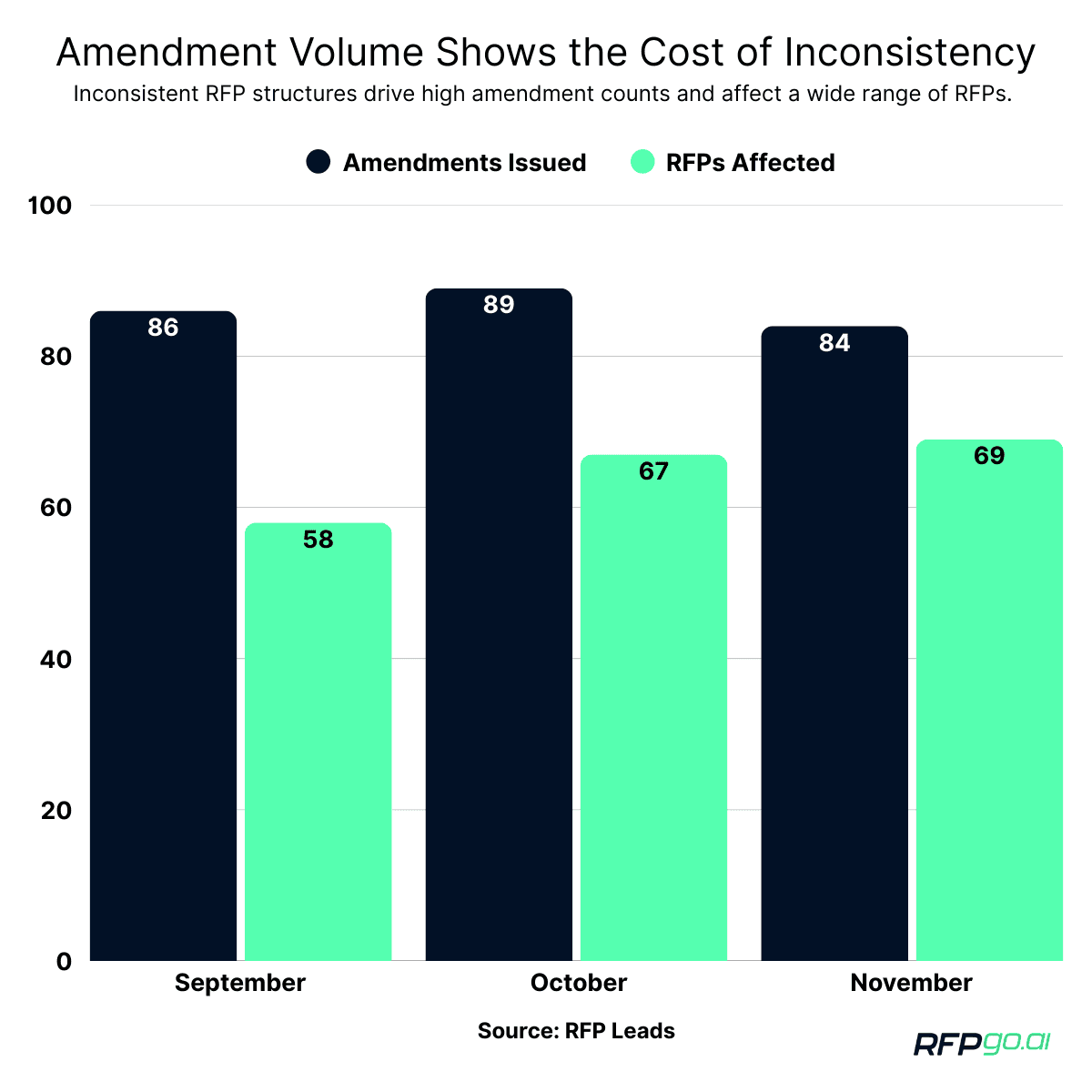
Three insights stand out:
Amendment volume remains consistently high. These are not anomalies—they’re structural symptoms.
The number of affected RFPs is rising. More RFPs mean more opportunities for inconsistency to surface.
Most amendments stem from clarifying questions, not scope changes. The underlying issue is how information is presented, not the work itself.
This is exactly what we would expect in an environment where businesses must interpret documents with no predictable structure.
3. The Data Reinforces What USDR and NASCIO Found
Our findings reinforce what the USDR and NASCIO uncovered through direct user research with NASCIO corporate members. Their report notes that businesses often struggle to determine if an RFP is relevant because essential information is “scattered across dozens or hundreds of pages.”
In other words, our amendment data reveals the downstream symptoms of the same upstream problem that USDR and NASCIO identified: an inconsistent RFP structure makes essential information hard to find, leading businesses to ask questions and governments to issue more amendments.
To address this, USDR tested a one-page summary sheet that surfaced essential information upfront. Businesses reported that it helped them understand the opportunity more quickly and made it easier to determine relevance.
4. Our Response: A Summary Sheet for Every RFP We Aggregate
Interestingly, we arrived at a similar solution independently. Through user research and discussions with government contracting officials, we developed our own standardized RFP one-pager.
We were delighted to see the USDR and NASCIO findings validate our approach.
On RFP Leads, we extend this methodology beyond IT RFPs to every RFP we aggregate, producing a consistent summary sheet across states, counties, cities, and formats.
Each summary sheet includes:
A Human-friendly RFP title
A plain-language RFP description
Publishing government entity
Key dates
RFP number
Budget information (if available)
Submission method and required documents
North American Industry Classification System Codes
Natural Language Tags
The result - Businesses can evaluate relevance in seconds, not hours.
5. Why This Matters — Especially for Small Teams
Small consultancies and founder-led firms feel this pain most acutely. Every hour spent deciphering a long, inconsistently formatted document is an hour taken from client work, planning, or proposal development.
A standardized summary sheet:
Reduces confusion
Lowers the number of clarifying questions
Cuts unnecessary amendments
Removes an avoidable friction point from the process
When the barrier to entry drops, more businesses can compete, and governments achieve higher levels of participation and stronger proposals.
6. Until Governments Standardize, We’re Filling the Gap
Standardizing RFP across governments will take time, coordination, and policy change. But businesses need clarity today.
Both our amendment data and USDR’s findings point to the same underlying issue: inconsistent structure is a system-level problem, not a one-off inconvenience.
RFP Leads fills this gap with a consistent, user-centered framework that reduces friction for everyone. When essential information is clearly surfaced, businesses understand the RFP and ask fewer clarifying questions, governments issue fewer amendments, and the procurement process becomes more efficient and effective.
That’s the procurement ecosystem we’re building—one RFP at a time.