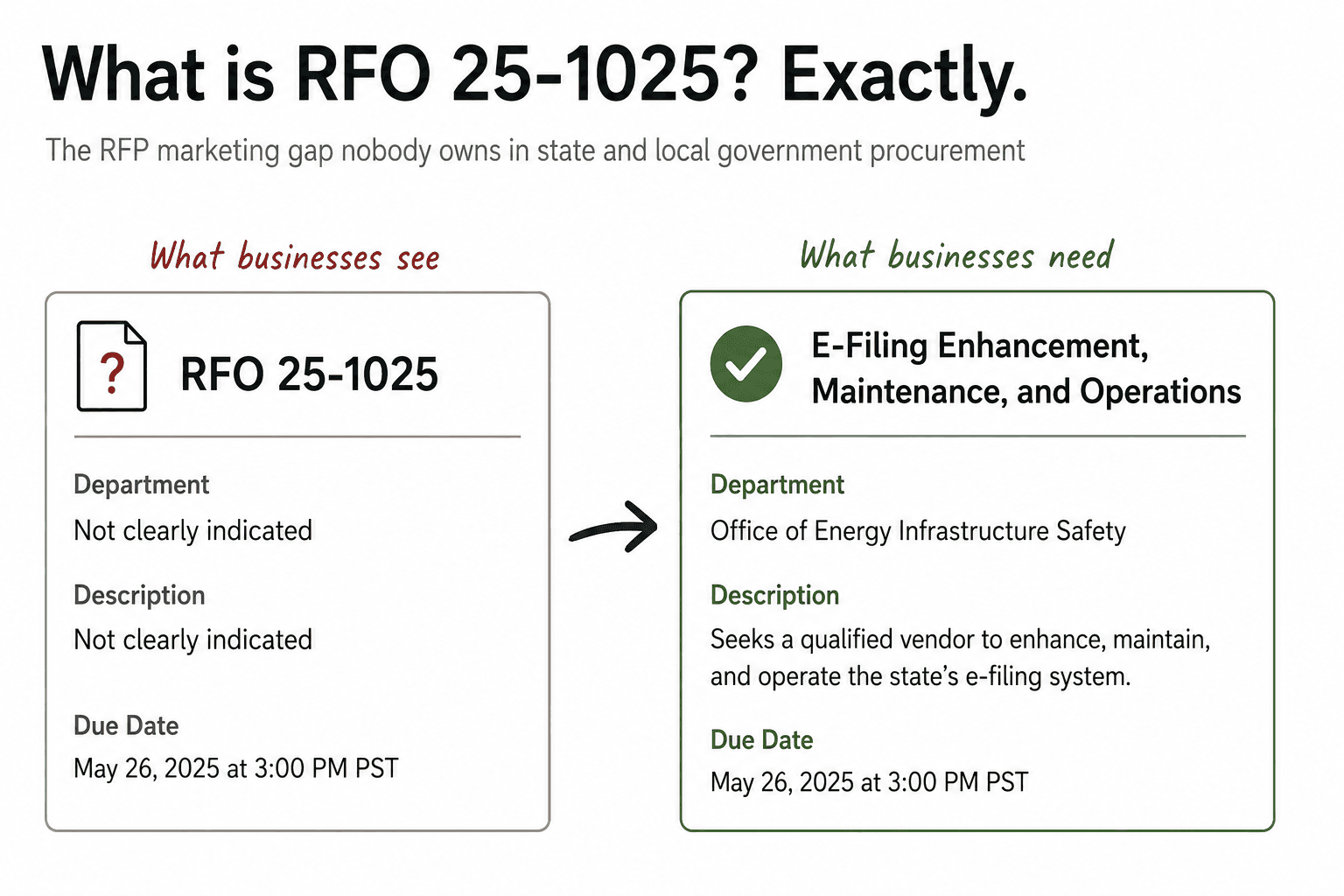
A recent public-sector opportunity was published with the title: RFO 25-1025.
That was it. No plain-language clue about what the government entity was buying. No indication whether the opportunity was for consulting, technology, facilities, planning, communications, engineering, or something else entirely.
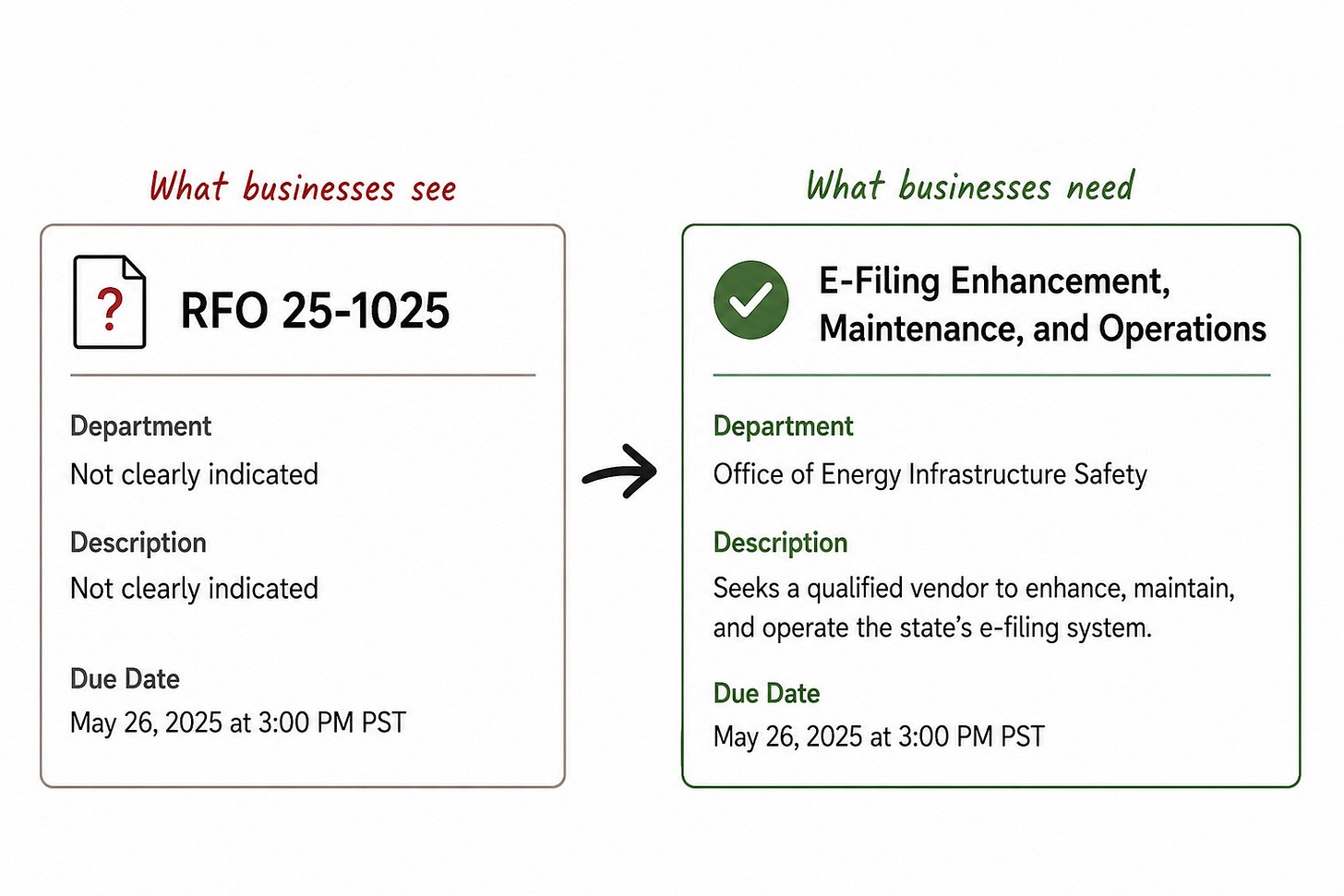
How this opportunity is currently listed.

For a business scanning opportunities, that title creates immediate friction. Should they click? Should they download the document? Should they spend time reading the scope? Is it even relevant to their company? Maybe. But the title does not help them decide.
That may seem like a small detail, but it is not. In state and local government procurement, where opportunities are scattered across municipal websites, procurement portals, PDF notices, and email alerts, the title is often the first signal a business sees. Sometimes it is the only signal. If that signal is incomprehensible, the opportunity is already harder to find.
Public notice is necessary
Public notice exists for good reasons. It supports transparency, fairness, competition, and accountability. It helps ensure that government opportunities are not quietly steered to a preferred business, and it gives the public visibility into how taxpayer dollars may be spent. Those protections matter.
But public notice is not the same as outreach, and posting an RFP online is not the same as reaching the market. A procurement process can satisfy the requirement to make an opportunity public while still making it difficult for qualified businesses to discover, understand, and act on that opportunity.
The opportunity may technically be available, but that does not mean it is findable. That distinction matters because state and local government procurement often proves that notice happened without proving that the right businesses actually saw, understood, or acted on the opportunity.
The gap nobody clearly owns
There is a gap in state and local government procurement between posting an RFP and making sure the right businesses actually know it exists.
Procurement may own the posting process. Departments may own the scope of work. A procurement portal may own the notification system. A municipal website may host the documents. A communications team may manage parts of the website. But the harder question is who owns the outcome of whether qualified businesses actually found the opportunity. In many cases, the answer is not clear.
That is the RFP marketing gap. The procurement system is often built to prove that opportunities were posted. It is not always built to measure whether the right businesses actually found them.
What I saw working within government
I saw this gap first-hand as someone who used to write RFPs from within government.
After months of writing and reviewing the contents of an RFP, the moment it was posted online often felt like the finish line. The scope of work had been drafted, reviewed, edited, approved, and finally published. From within government, that felt like a major milestone because it was. A lot of work had gone into getting the document ready.
But once the RFP was posted, the outreach often stopped there. There was no broader distribution plan, no intentional effort to ensure the right businesses understood the opportunity existed, and no real check to see whether the market had been reached.
Looking back, I think I assumed someone else owned that part of the process. If the RFP was posted, the notice went out, and the right boxes were checked, I assumed the opportunity had reached the market. Over time, I realized that assumption was the gap. The posting was owned. The notice was owned. The document was owned. But actual market awareness was not clearly owned by anyone.
Part of the reason is cultural. In public procurement, “marketing” an RFP can feel risky, as if promoting the opportunity might create an unfair advantage. That concern is understandable. Procurement should be fair, open, and competitive. But making an opportunity easier to find is not the same as steering it to a preferred business.
By “marketing,” I do not mean promoting an opportunity to select companies. Making a public opportunity clear, searchable, and visible enough for the relevant market to find it. That distinction matters.
Sent is not the same as seen
The practical check for business awareness was often whether an email notification had been sent to companies registered under the relevant NAICS or commodity codes.
But “sent” is not the same as “seen.” It does not tell you whether the email was opened, read, forwarded to the right person, understood by a qualified business, or acted on. It only tells you that a notification went out.
That is not a criticism of the people doing the work. It reflects how the procurement system is often structured. The process can confirm that notice was sent, but it may not tell anyone whether the notice reached the right audience in a meaningful way.
A business could be registered under slightly different codes. The right person inside the company may never see the email. The title may be too vague to catch their attention. The opportunity may require opening a dense PDF before the business can even tell whether it is relevant. All of that creates friction before a business even reaches the starting line.
The system is built around posting, not discovery
Many state and local procurement processes are built around publishing the opportunity. The process typically asks whether the RFP was posted, whether the notice was sent, whether the deadline was listed, and whether the documents were made available. Those are important questions, but they are not enough.
A better question is whether businesses had a realistic chance of finding, understanding, and responding to the opportunity. That question is harder to answer because it does not fit neatly into a single function. It lives somewhere between procurement, departments, communications, IT, business outreach, and the procurement platforms themselves.
When the process is built around posting rather than discovery, the burden shifts to businesses. They have to know which websites to check, which portals to register for, which codes to select, which email alerts to trust, and where to look for addenda. They also have to read through dense documents just to decide whether an opportunity is relevant.
For a business, this can make government contracting feel less like business development and more like detective work.
Why the gap matters
When qualified businesses miss an RFP, governments lose too.
Fewer companies in the know can mean less competition, fewer ideas, weaker proposals, higher costs, or less specialized expertise at the table. This is especially important in state and local government procurement, where many opportunities are a strong fit for small and mid-sized professional service businesses.
The issue is not always that companies are uninterested in public-sector contracting. Many are interested. The issue is that the discovery process is fragmented, inconsistent, and time-consuming. Some opportunities are posted on centralized procurement portals. Others live on municipal purchasing pages. Some are buried in PDFs. Some require businesses to register under the right commodity code. Some rely on email notifications. Some have addenda in one place and original documents in another. And some are published with titles that give the market almost nothing to work with.
Better RFP marketing does not mean favoritism
Improving RFP marketing does not mean giving some businesses special treatment. It does not mean steering work, weakening procurement rules, or compromising the integrity of the procurement process. It means making public opportunities more discoverable, understandable, and accessible to the business market.
That can be done in practical ways:
Use clearer RFP titles that describe what is being purchased.
Include plain-language summaries before asking businesses to open a long PDF.
Improve category tagging so opportunities reach the right market.
Make opportunity pages searchable.
Keep original documents, addenda, exhibits, and submission instructions easy to find in one place.
Make addenda notifications reliable.
Use consistent headings and numbering schemas to make navigation easier.
None of those changes gives one business an unfair advantage. If anything, they make the process more open and easier to manage. Fairness is not only about making an opportunity technically available. It is also about reducing unnecessary friction so qualified businesses have a real chance to compete.
Public is not the same as findable
The uncomfortable truth is that many RFPs are not really marketed. They are posted.
And once they are posted, the procurement system often treats the job as complete. But if the goal is real competition, posting should be the beginning of the process and not the end.
Public notice answers one question: Was the opportunity made available?
Business outreach asks a different question: Did businesses actually know about it?
That second question deserves more attention. Somewhere right now, a government entity may have a legitimate need and funding available. Somewhere else, a qualified business may be a strong fit for the work. But if the opportunity is published under an incomprehensible title, buried on a website, hidden in a PDF, or sent only through a narrow commodity-code alert, they may never find each other.
That is the gap. And until someone owns it, too many good opportunities will continue to be missed.
What we do:
RFPGo.ai solves this problem. For example, we made this opportunity easier to understand by transforming the title from “RFO 25-1025” to “E-Filing Enhancement, Maintenance, and Operations” and paired it with a clear description. Instead of requiring a business to open the full document just to understand the opportunity, we make key RFP details easier to identify in seconds. We do this across hundreds of government entities in the Pacific Northwest and California to help businesses discover relevant public-sector opportunities faster.